


RJ Lindelof

Board, Advisory, and Executive Roles RJ Lindelof Considers

RJ Lindelof in a boardroom conversation

The door is always open

Not Searching. Always Listening.

I am not actively looking, and I am not hard to reach either. If you are building a company where a VP of Engineering, CTO, or CEO with real operating depth would change the trajectory, I want to hear about it. For the right company and the right fit - let's talk.

This page exists so a recruiter, founder, or operating partner can decide in two minutes whether that conversation is worth having. It lists the roles I consider, where I am a good fit, and where I am not.

  • VP of Engineering
  • CTO
  • CEO
  • Board
  • Advisory

Executive roles

VP of Engineering, CTO, CEO

The right situation

VP of Engineering

An engineering organization that has to grow or speed up without breaking. I have grown one from 30 to 175+, with 80% of that growth in a single nine-month window, while holding a 99.95% SLA. Delivery cadence, CI/CD, platform engineering, and the management layer are the work.
The right situation

Chief Technology Officer

A regulated B2B SaaS company with a platform to modernize and an AI strategy that needs to become an AI practice. Technology strategy, architecture, AI governance, vendor decisions, and a clear story for the board about cost, risk, and payback.

The right situation

Chief Executive Officer

A software company where the product is the business and the next stage of growth depends on engineering execution. I am CEO of RJL Software, Inc., founded in 1994, and have spent two decades translating between engineers, product leaders, and investors.

The record behind each of these is on the career timeline and track record. I work remotely and have led distributed teams since 2012.

Board and advisory

Board and Advisory Roles

Plainly

I do not hold a board or advisory-board seat today. I am open to the right one, and I would rather say that than pad a list.

What I bring to a board or an advisory relationship:

  • Technology risk in plain language. What the platform can and cannot do, what it will cost to fix, and what happens if nobody does.
  • AI strategy with a production bias. Where AI will move a real metric, what governance it needs in a regulated business, and what it should cost. The right model is the cheapest one that clears the bar.
  • Engineering organization health. Whether the team can deliver the plan the board just approved, read from delivery data rather than from the status deck.
  • An operator's view. Two decades of carrying out what boards and investors decide, which teaches you which decisions engineering can absorb and which ones quietly cost a year.

Investors

For Private Equity and Venture Investors

What I have done, not what I could theoretically do.

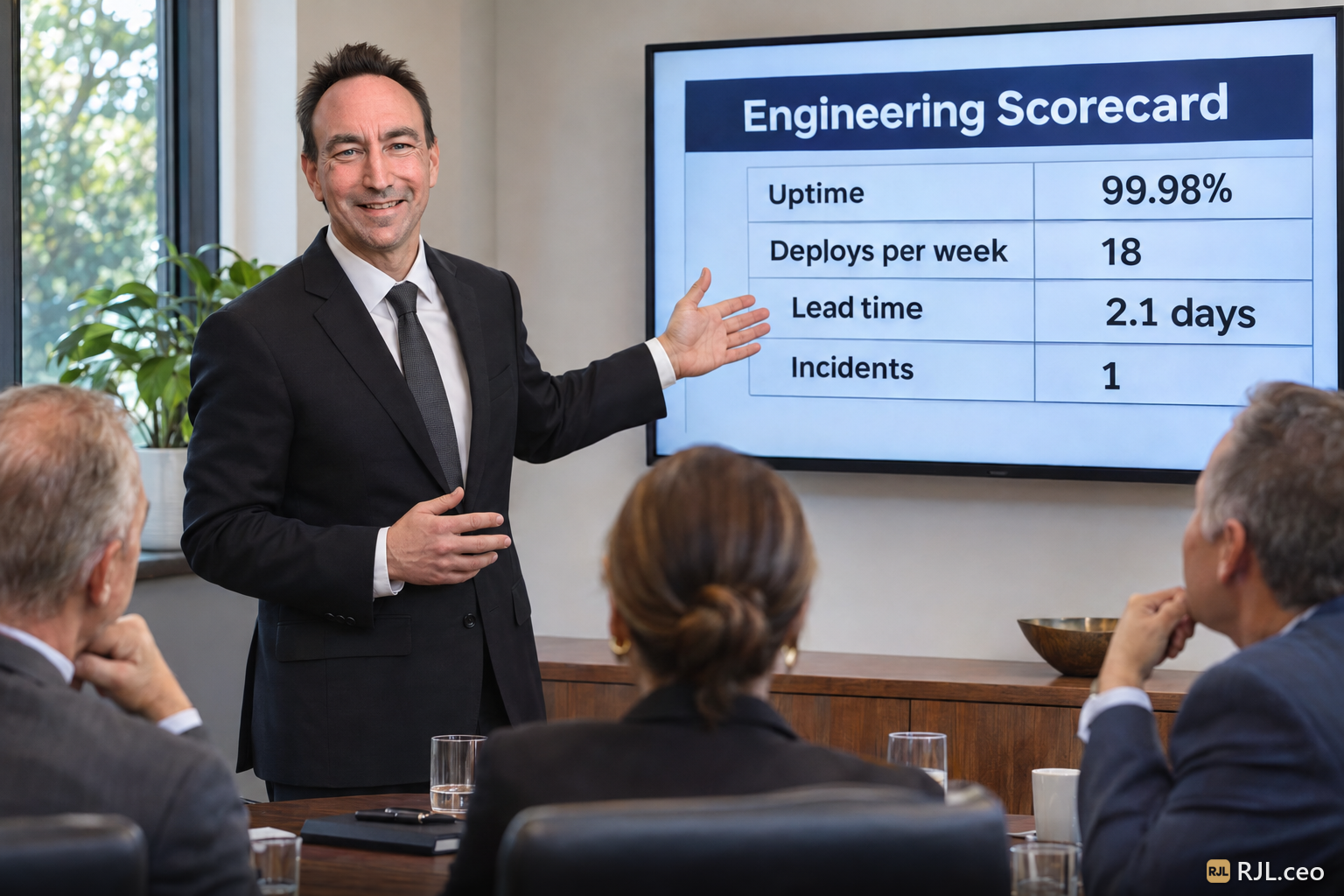
RJ Lindelof presenting an engineering scorecard to a board of directors
One page, a handful of numbers, and a straight answer about what they mean.
  • Technical due diligence and post-close integration on multiple acquisitions at Follett, and post-merger integration at hc1.
  • Investment cases for PE advisors. At PE-backed Successware I presented architecture and investment cases directly to PE advisors, investors, and the C-suite, and secured approval for a mobile platform that was delivered on schedule and within budget.
  • Scaling under a growth plan. Engineering from 30 to 175+ with a 40% cut in code-to-release cycle time and a 30% cut in mean time to recovery.
  • Cost discipline. A 90% cut in LLM inference cost in my current role, and 65% of technical debt retired at GlobalMed.

If you are assessing a software company, or you own one and the technology story does not match the numbers, that is a conversation I can be useful in.

Fit

Good Fit, and Not a Fit

A good fit

  • B2B SaaS in a regulated industry: HealthTech, EdTech, GovTech, FinTech.
  • PE-backed, venture-backed, or founder-owned, with a growth or modernization mandate.
  • A platform that has to be rebuilt while it keeps earning.
  • A leadership team that wants AI in production with governance, not a press release.
  • Distributed teams, or the willingness to become one.
  • A product partner who wants engineering in the room when the problem is defined.

Not a fit

  • AI theater. If the goal is a demo for the next board meeting and nothing after it, I am the wrong hire.
  • Engineering as an order-taker. I will ask what problem we are solving, for whom, and why now. Every time.
  • Offshore teams treated as a ticket queue. There are no second-class engineers in an organization I run.
  • A culture that prefers the loudest voice to the data.
  • A calendar where status meetings are mistaken for architecture.

Process

How a Conversation with RJ Starts

  1. A message

    Use the contact form. Say who you are, what the company does, and what problem the role is meant to solve.

  2. A call

    A first conversation about the business, the team, and the real constraint. I will ask more questions than I answer.

  3. The evidence

    References, the recommendations on the career page, and a straight answer from me on whether I think it is a fit.

Have a role or a seat in mind?

Start with a message. Company, stage, and the problem you need solved.

Contact RJ